Earn $$$ Per Click!

Sunday, March 02, 2008

China Is No. 1

Brian Wingfield, 02.26.08, 10:00 AM ET
Washington, D.C. - China's a big-number nation. The world's largest population (1.3 billion people). The world's most valuable company ( PetroChina). The fastest-growing economy (9.7% rate annually since the 1970s), which will probably surpass Germany as the world's biggest merchandise exporter in 2008.

What's more, when researchers at Georgia Tech recently graded the high-tech competitiveness of 33 countries on a 100-point scale from 1996 to 2007, China skyrocketed to the top ranking while the U.S. fell from its 1999 peak. If this trend continues, China could soon replace the U.S. as the main engine of the world's economy, the study suggests.

Small wonder pundits have long said the 21st century belongs to China. And perhaps there's no better way of getting a sense the country's size and ambitions than by looking at the numbers. Viewed through this lens, you see that China already leads the world in a host of critical categories.
In Pictures: Areas Where China Is No. 1
China has $1.53 trillion in foreign exchange reserves, about $500 billion more than Japan, the next largest holder. It produces more clothing, cement, gold and steel than any other country. In 2006, it had 2.4 million university graduates, more than the U.S., Japan and France combined. By 2011, China is expected to become the world's largest energy consumer, a title now held by the U.S.

According to government statistics, China manufactured 8.8 million autos in 2007, a 22% increase from the previous year. That's still far behind the U.S., but one analyst estimates China could catch the U.S. in auto production by 2012.

The industrial boom has put China on pace to surpass the U.S. in energy consumption shortly after 2010, according to the Paris-based International Energy Agency. In addition, a 2007 report by the Netherlands Environmental Assessment Agency found that China is now the world's leading producer of harmful carbon dioxide emissions.

Need more examples of China's galloping growth? According to official statistics from the Chinese government, last year economic growth increased by 11.4%, China's state-owned companies posted a 32% rise in profits and foreign direct investment in China amounted to $11.2 billion--a 110% increase from the previous year.

All this, and the World Bank recently reported that the country's growth is actually slowing down, albeit gradually. In January, Beijing announced that consumer inflation rose by 7.1% in 2007, the highest level in 11 years, due largely to rising food prices. And China's worst winter in two decades is causing blackouts, highway closures and crop destruction--so far, the economy has taken a $15 billion hit, the government says.

The Chinese would probably welcome a mild slowdown. Since 2004, China has tried with little success to rebalance its economy by promoting more consumption at home and less investment and export-led growth. The best way for China to adjust, experts say: Spend more, save less.

Despite occasional spats over trade and the exchange rate between the dollar and the yuan, Washington and Beijing are working together to help China manage its growth and to become a more integrated member of the world economy. In 2006, the U.S. and China began their "strategic economic dialogue," which has become the centerpiece of U.S.-Sino relations. On the U.S. side, Treasury Secretary Henry Paulson--who traveled to China frequently when he was chairman of Goldman Sachs (nyse: GS - news - people )--has led the effort.
In spite of its impressive gains, China still has a long way to go before it becomes a full-fledged market-based economy. According to Wing Thye Woo, a senior fellow at the Brookings Institute, China needs to take a more assertive role in international trade negotiations. There is concern that the Chinese bureaucracy could stunt growth of its industries. And with rapid growth always comes social change, which China is keenly aware of.

"The Chinese have to set up social and political institutions that could mediate competing interests," says Woo. "Unless they can do that, the economic growth might not be sustainable."

Technological Competitiveness
No. 1: China
No. 2: U.S.
If China retains its competitive edge in hi-tech exports, it could soon replace the U.S. as the main driver of the global economy, says a 2008 report by Georgia Tech researchers. The study graded 33 nations' technological competitiveness on a 100-point scale. China reached the top position for the first time in 2007.

Carbon Emissions
No. 1: China
No. 2: U.S.
A 2007 study by the Netherlands Environmental Assessment Agency found that China's carbon dioxide emissions surpassed those of the U.S. by 8% in 2006. The main reasons: increases in cement production and coal consumption. According to the World Bank, 20 of the world's 30 most polluted cities are in China.


Foreign Currency Reserves
No. 1: China
No. 2: Japan
China's trade surplus grew by a record 48% in 2007, according to the country's central bank. As a result the country has the largest store of foreign exchange reserves in the world, about $1.53 trillion as of December. (Japan's are just shy of $1 trillion. About $200 billion of this is invested in a sovereign wealth fund, the China Investment Corp.)

Energy Consumption
No. 1: U.S.
No. 2: China
The International Energy Agency predicts that China could surpass the U.S. as the world's largest consumer of energy soon after 2010. China increasingly relies on coal and imported oil to feed its growing energy appetite. One bright spot: The government aims to obtain 15% of its energy from renewable fuel sources by 2020.

Most Valuable Company
No. 1: China (PetroChina)
No. 2: U.S. (ExxonMobil)
PetroChina's market capitalization soared past $1 trillion when it debuted on the Shanghai Stock Exchange in 2007. That made it twice as valuable as the world's second-largest company, U.S.-based ExxonMobil. However, PetroChina trades at a much lower valuation on other stock exchanges, and its profits are a fraction of Exxon's. Consulting firm PFC Energy recently estimated PetroChina's market cap to be $723 billion.
Gold Production
No. 1: China
No. 2: South Africa
In 2007, China surpassed both South Africa and the U.S. as the world's largest producer of gold, according to GFMS, a London-based precious metals consulting firm. Low production costs and record gold prices are contributing to a Chinese boom in bullion. The government says that from 2006 to 2010, it plans to increase its holding of gold by 600%.

Merchandise Exports
No. 1: Germany
No. 2: China
According to the World Trade Organization, China began to overtake the U.S. as the world's second-largest merchandise exporter in the second half of 2006, even though the U.S. held the No. 2 spot overall that year. China produces more textiles and clothing than any other country in the world. Official statistics aren't in yet, but China undoubtedly passed the U.S. in merchandise exports throughout 2007, which would bump the U.S. to the No. 3 spot.

National Savings Rate
According to the World Bank's latest figures, China saved 50% of its national income in 2007, by far the highest rate among the world's major developing or industrialized countries. That's a problem because it shows that economic growth is lopsided--too heavy on exports and investment, not enough consumption. China's citizens save about 25% of their net pay (in the U.S., this rate is less than 1%), but Beijing wants to see more spending, less saving.
From the facts above, China is truely conquer the world now. The future market for China is bright, let see how the government there able to sustain the demand after Beijing Olympic 08'

Tuesday, February 19, 2008

Important about our human body - Liver


Good rest and sound sleep is very Important...
If u don't sleep well,
The toxic in your body will accumulate..
Affecting your health and your mood...

The main causes of liver damage are:

1. Sleeping too late and waking up too late are the main cause.
2. Not urinating in the morning.
3. Too much eating.
4. Skipping breakfast.
5. Consuming too much medication.
6. Consuming too much preservatives, additives, food coloring, and artificial sweetener.
7. Consuming unhealthy cooking oil. As much as possible reduce cooking oil use when frying, which includes even the best cooking oils like olive oil. Do not consume fried foods when you are tired, except if the body is very fit.
8. Consuming overly done foods also add to the burden of liver. Veggies should be eaten raw or cooked 3-5 parts. Fried veggies should be finished in one sitting, do not store.

We just have to adopt a good daily lifestyle and eating habits. Maintaining good eating habits and time condition are very important for our body to absorb and get rid of unnecessary chemicals according to "schedule."


Because: Evening at 9 - 11pm : is the time for eliminating unnecessary/ toxic chemicals (de-toxification) from the antibody system (lymph nodes). This time duration should be spent by relaxing or listening to music. If during this time a housewife is still in an unrelaxed state such as washing the dishes or monitoring children doing their homework, this will have a negative impact on her health.


Evening at 11pm - 1am : The de-toxification process in the liver, and ideally should be done in a deep sleep state. Early morning 1 - 3am : de-toxification process in the gall, also ideally done in a deep sleep state.

Early morning 3 - 5am : de-toxification in the lungs. Therefore there will sometimes be a severe cough for cough sufferers during this time. Since the de-toxification process had reached the respiratory tract, there is no need to take cough medicine so as not to interfere with toxin removal process.
Morning 5 - 7am : de-toxification in the colon, you should empty your bowel.

Morning 7 - 9am : Absorption of nutrients in the small intestine, you should be having breakfast at this time. Breakfast should be earlier, before 6:30am, for those who are sick. Breakfast before 7:30am is very beneficial to those wanting to stay fit. Those who always skip breakfast, they should change their habits, and it is still better to eat breakfast late until 9 -10am rather than no meal at all. Sleeping so late and waking up too late will disrupt the process of removing unnecessary chemicals. Aside from that, midnight to 4am is the time when the bone marrow produces blood.

Therefore, have a good sleep and don't sleep late.

Monday, February 11, 2008

The Basics of Moneymaking

A basic question to all prospects as a business leader:

How does your company make money?


Many MBAs can't answer it. Many CFOs and vice presidents can't answer it. Experienced CEOs sometimes struggle to answer it.


The Universals of Business
At the core of every successful business, from a global giant to a corner store, are the same fundamentals of moneymaking: cash, margin, velocity, return, and growth. And at the core of every successful business leader is an intuitive understanding of the relationships among them.


It's easy to think the basics of business are for beginners. Everyone knows what cash is, and that companies must make a profit.


But business acumen isn't about knowing definitions. It's about keeping the basics of moneymaking in sharp focus and balancing them in a way that's healthy for the business.


When you have business acumen, you realize the importance of every job at every stage of your career. A mailroom clerk with business acumen knows that getting checks to the accounts receivable department more quickly will ease the company's cash flow. And a sales rep with business acumen knows that higher-margin products will increase the company's return.


Moneymaking Basics

As the complexity of your job increases, it's easy to lose sight of the fundamentals. If your business acumen doesn't develop, you can stumble -- focus too much on revenue growth and overlook cash, or focus too much on cash and overlook growth.

That's why you should never consider it beneath you to revisit the moneymaking basics. They should be front and center in your diagnosis and decision making in every job you have.
Here are the basics:

• Cash
No business survives long without it. You should know how much cash your business generates and how much cash it consumes.

What are the sources of it? What drains it? What's the timing of the inflows and outflows and how is it changing? More revenues (sales) often means more cash. But growing a business consumes cash. How fast can the company expand without straining its cash flow?


• Margin
When people talk about the bottom line, they generally mean net profit margin -- the money the company earns after paying all its expenses, interest, and taxes. But gross margin is important, too.


Gross margin -- the difference between a product's selling price and what it costs to make the product (the "costs of goods"), expressed as a percent of the selling price -- can signal important shifts in a business. When PC makers saw their 32 percent gross margins decline to 20, they knew (or should have known) the competitive landscape had changed.


You have to know how changes inside or outside the business affect gross margin. Are there new entrants in the market who are winning customers? A competitor who's found a clever way to reduce costs and prices? A change in the pricing power of suppliers?


• Velocity
Velocity refers to speed, turnover, or movement.

How much revenue do you turn over, or generate, for each dollar of inventory? If you have $1 million in inventory for the year and revenues of $10 million, your inventory velocity is 10. This tells you how fast you're moving raw materials through the factory, turning them into finished products, and moving those products off the shelf to customers. The faster, the better.

Service businesses can track velocity, too. For banks, velocity of equity -- how much revenue is generated per dollar of equity -- is a useful measure. The concept applies to every business.

• Return
Margin multiplied by velocity equals return. If your return is lower than your cost of capital, your business is likely to be in trouble. That's when shareholders get concerned.

How do you boost your return? See if you can boost your margin or increase your velocity -- or, better yet, both.

• Growth
Every business needs to grow to stay in business. How do you grow in a way that keeps the other aspects of moneymaking in balance? There's no formula -- people with business acumen figure it out.


Where Business Acumen Counts Most

Street vendors in villages around the world use business acumen every day. They have to -- their next meal often depends on it.

In companies, business acumen is crucial when the external world changes and there's a need to reposition the business.

Like when Hollywood studios started selling videocassettes directly to the public at the same time it sold them to video rental companies. That's when Blockbuster's rental business started to slide.

People wanted to buy movies, not just rent them, so Blockbuster started selling them. But the moneymaking was completely different.

Blockbuster was used to buying videocassettes on credit and making payments with the cash from renting them. Returns were high.

Selling videocassettes meant laying out the cash up front, holding lots of inventory, and waiting for the cash to come in when the videocassettes were sold. Cash flow, velocity, and return were all adversely affected.

Where Do You Want to Go?

You don't need business acumen to make a meaningful contribution to a business. But you'll need it to rise through the leadership ranks.

You can't acquire it at a seminar or in a quick read. You learn it by using it in real business situations.

Start now by applying it to your company. Ask for the numbers or pull them from the annual report. Precision isn't necessary -- knowing what to focus on is.

Posted on Wednesday, June 6, 2007, 12:00AM by Ram Charan

Sunday, February 10, 2008

Why the Rich Get Richer


A few days ago, a reporter asked me if I was losing money in real estate. My reply was, "No, I'm making money."

Confused, he asked, "How can you be making money during the subprime disaster?" I explained that since the real estate market took a downturn, there were more people renting rather than buying, which is great for my apartment business. I also informed him that I'm raising rents since demand for affordable apartments is so high. When someone moves out, I increase the rent and new tenants line up, which means my cash flow is increasing.


He then asked, "Are you looking for new investments?"


A shocked look came over his face when I said, "I've been investing heavily in the stock market since August 2007. I've moved several million dollars into the market."


"The stock market?" he stammered. "Stocks are crashing. Why are you in the stock market? Besides, I thought you were a real estate investor?"

Ignorance Isn't Bliss

As Warren Buffett has said, it's important for society to have accurate and informed sources of information. While I agree, I sometimes wonder about the intelligence of many financial journalists, both in print and the electronic media.


For example, lately on financial TV stations, the reporters have been talking about the run-up in gold and asking, "Is it time to invest in gold and gold stocks?" What a ridiculous question. Now isn't the time to be investing in gold or gold stocks -- that time was 10 years ago, when gold was below $300 an ounce. Investors should've taken substantial positions when gold was cheap. For reporters to be talking about gold today is no different than them reporting on the hot real estate market in 2005, just before the top blew off.


I had dinner with a friend of a friend the other night and he was telling me about the Rothschild formula for investing. According to him, this involves not participating in the first 20 percent or the last 20 percent of an investment run-up. Instead, it's investing in the middle 60 percent, when risks are low and the direction of the price is determined. As the asset value approaches what appears to be the last 20 percent, you sell and move on to another asset class.
As we all know, most amateurs (and, possibly, many reporters) only participate in the last 20 percent.

Take Notes

I wondered if the reporter who asked why I was investing millions in stocks was an investor himself. I did my best to explain to him that there are two things professionals invest for:

1) Capital gains, and

2) Cash flow.


I said, "The amateurs who come in at the top 20 percent of a market are generally investing only for capital gains. In the last real estate boom, the 'flippers' who got no-document, zero-down loans paid very high prices, and hoped for a greater fool than them to take the property off their hands.

"These are some of the people being faced with forecloses today. They're the investors who make the news -- not the investors who are making money."


The reporter then asked me, "So what do you invest for?"


My reply? "Both. If I can, I want both capital gains and cash flow."


I went on to explain that I was investing millions in stocks that were paying a high dividend -- cash flow -- and also had their prices battered down by the market crash, a loss of capital gains.


Spelling It Out

He wasn't the brightest reporter, since he had trouble with the idea of investing for both cash flow and capital gains. After about an hour of explanation, he finally began to understand that I'm not just a real estate investor -- I'm someone who invests for capital gains at a great price, or cash flow at a great price, regardless of the asset class. If the deal is right, it doesn't matter if it's in real estate, commodities, a business, or paper assets.


Here's an example of capital gains for a great price: Back in the 1990s, every time I had some extra cash I would buy some gold or silver. Although I didn't receive any cash flow from gold or silver I knew I was purchasing the metals at a great price, and that someday those prices would rise again.


An example of buying for cash flow at a great price is when I buy a stock that pays a dividend. I wait until the stock market dips and then buy, which is what I'm currently doing. One of the better companies I've been buying is a bulk cargo shipping company that's hauling U.S. grains to India. The more the dollar drops in value, the more grains we export. Every time the market drops, I buy more of this stock at a great price, because I love the cash flow from dividends.


Finally, an example of buying both capital gains and cash flow at a great price is when I find an apartment building at a bargain, and then increase the rents. By doing so, I increase the cash flow and the property value, which translates into capital gains.


Leave It to the Pros

When I watch professional football, I love listening to John Madden because I know he knows what he's talking about. He's been both down in the trenches and in front of the bench as a coach. He knows the game. By that token, one financial reporter I respect is Bloomberg's Kathleen Hayes. She's a savvy reporter who knows what she's talking about. I wonder about some of the other financial reporters.


The problem with much of the financial news in print and on the web, radio, and television is that it comes from journalists who may not be investors. When I listen to most journalists whine and cry about the subprime mess, the slowdown in the economy, and the volatile stock market, I can all but tell that they're not really investors. None of these events really has much impact on professional investors, who follow market trends and are familiar with the underlying fundamentals of the assets they investing in.


So the next time you hear a reporter ask, "Is this the time to be getting into stocks, bonds, real estate, gold, silver, or oil?" remember that it's probably the time to be looking elsewhere. And keep in mind the Rothschild formula of investing. You never want to be too early -- and you also never want to be too late.


Posted on Thursday, January 17, 2008, 12:00AM by Robert Kiyosaki

Thursday, February 07, 2008

China

http://link.brightcove.com/services/link/bcpid1155389201/bclid1236266814/bctid1400494757

Tuesday, February 05, 2008

Way Back Into Love

st time i watch a video in YouTube with 4,900,275 views ( as of 5 Feb, 2008 )
4,120 comments and 18,850 rate as favorite!!
No doubt is one of the best love song. Anyone know the movie title?
Hugh Grant - Way Back Into Love
[Verse 1]
(Drew Barrymore)
I've been living with a shadow overhead,
I've been sleeping with a cloud above my bed,
I've been lonely for so long,
Trapped in the past,
I just can't seem to move on!

(Hugh Grant)
I've been hiding all my hopes and dreams away,
Just in case I ever need them again someday,
I've been setting aside time,
To clear a little space in the corners of my mind!

[Chorus](Both)
All I want to do is find a way back into love.
I can't make it true without a way back into love.
Oooooh.

[Verse 2]
(Drew Barrymore)
I've been watching but the stars refuse to shine,
I've been searching but i just don't see the signs,
I know that it's out there,
There's got to be something for my soul somewhere!

(Hugh Grant)
I've been looking for someone to shed some light,
Not somebody just to get me through the night,
I could use some direction,
And I'm open to your suggestions.

[Chorus](Both)
All I want to do is find a way back into love.
I can't make it through without a way back into love.
And if I open my heart again,
I guess I'm hoping you'll be there for me in the end!
Oooooooh, Ooooooh, Ooooooh.

[Middle-eight](Drew Barrymore)
There are moments when I don't know if it's real
Or if anybody feels the way I feel
I need inspiration
Not just another negotiation

[Chorus](Both)
All I want to do is find a way back into love,
I can't make it through without a way back into love,
And if I open my heart to you,
I'm hoping you'll show me what to do,
And if you help me to start again,
You know that I'll be there for you in the end!
Oooooooh. Oooooooh. Ooooooooh. Oooooooh. Ooooooh Ooooooooh.
Ooooooooh.

Sunday, January 27, 2008

8 Things Everyone Should Know About Gold by James Turk

Gold is one of the world’s most misunderstood assets. There are many reasons for this unfortunate situation, but one stands out. Gold exists in an environment in which there are many powerful forces fiercely hostile to it. Most notable among these are governments and the myriad of vested interests that feed from the public purse or rely upon some government-issued license or privilege. Governments have confiscated gold, taxed it, propagandized against it and even outlawed it.

Gold does not have any powerful sponsor championing its cause. In fact, the opposite prevails. Apologists for central banks as well as government toadies clamoring for continued state control of money have worked hard to discredit gold where possible, for example, by blaming it for things it was not responsible – like the Great Depression – and by denigrating gold as a fondling of speculators or a superstition better suited for primitive economies.

In short, conventional economic wisdom and monetary thinking has one aim; it is to justify and perpetuate today’s monetary system. It does not undertake a critical review of the system nor take an unbiased, unprejudiced look at alternatives such as gold.

Yet despite this hostile environment, gold continues to be valued throughout the world. Stripping away the misinformation and half-truths about gold, it is clear that gold continues to serve an important role. Why is that?

It is because gold is useful, and as a consequence, it therefore has value. And how does gold’s usefulness arise?

Here is a basic primer highlighting eight essential features of gold that everyone should know. By evaluating them, it is possible to determine whether gold’s usefulness could be of value to you, just as it already is of value to countless millions of people around the world.

1) Gold is a special, unique commodity

Gold is a special, unique commodity because it is the only commodity produced for accumulation; all other commodities are produced to be consumed. Essentially all of the gold mined throughout history still exists in aboveground stocks. Nevertheless, gold is rare.

The entire aboveground gold stock is only about 155,000 tonnes. If all this gold were put into one lump, its size would be 8,000 cubic meters, the volume of which is equal to the bottom one-fifth of the Washington Monument or 3¼ Olympic size swimming pools. It is also astonishing to note that in one day twenty-times more steel is poured than the total weight of gold mined throughout history.

2) Gold’s supply is its aboveground stock

Because it is accumulated and not consumed, gold’s supply is its aboveground stock. This fact changes everything in terms of how to analyze gold.

Gold’s price is still a function of supply and demand, but the supply that matters is not the relatively little amount mined each year, which history shows only increases the aboveground stock year after year by a relatively consistent 1.7% per annum. Rather, gold’s supply is the total weight accumulated in its aboveground stock for the simple reason that a gram of gold mined today is no different from a gram of gold mined by the Romans two-thousand years ago. In other words, gold in the aboveground stock is perfectly substitutable for newly mined gold.

In the short-term gold’s supply is relatively unchanged because new mine production cannot be meaningfully increased quickly. As a consequence, gold’s price is principally a function of demand.

While it is common to hear that gold’s price is determined by jewelry demand, that belief is misguided. Just like wet streets do not cause rain, the price of gold does not depend upon jewelry demand. The important point is not the form gold takes when it is fabricated, but rather, the use to which it is put. Most jewelry is high-karat gold acquired because of gold’s monetary characteristics, not for reasons of adornment.

Therefore, the price of gold – or more precisely because it is money – gold’s rate of exchange to national currencies depends upon monetary demand, or what some people mistakenly call its investment demand. It cannot possibly be otherwise, given that gold’s supply is its aboveground stock and that some 80% of this amount is held for monetary reasons, and not for fashion, adornment or other factors.

3) Gold is money

This observation about monetary demand means that gold is money. In other words, gold is hoarded because its greatest usefulness arises from those attributes that make it money.

Gold’s advantages as money are numerous. Perhaps most important in our present age marked by the perennial inflation of national currencies, gold is money that cannot be debased by creating it ‘out of thin air’ by government fiat.

Another important factor in gold’s favor is the mountain of debt and financial derivatives that overhang the world economy. Gold is the only money that is not contingent upon anyone’s promise, an attribute that explains why gold is called “sound money”.

4) Gold is an alternative to the US dollar

The US dollar is in trouble because it is being debased – it is being inflated by newly created dollars that are used to fund the growing federal government budget deficits and other public and private debt. This insidious inflation erodes the purchasing power of the dollar month after month. Consequently, more and more people are turning to gold as their preferred money.

It used to be that the dollar was “as good as gold”. The dollar achieved that distinction because it was formally defined as a weight of gold under the rule-based system known as the gold standard. Under that system, which ended in August 1971, gold and dollars were interchangeable and essentially the same. But no more, to the detriment of those who hold dollars. By some estimates, the dollar has lost more than 90% of its purchasing power since then.

Despite this dreadful deterioration the dollar has suffered, it continues to circulate as currency. Those same inexorable forces that create a hostile environment for gold are at the same time promoting and propagandizing the dollar to talk-up its demand. The Federal Reserve’s pro-dollar, anti-gold propaganda is aimed to maintain the illusion that the dollar is reliable money. Consequently, in contrast to their interdependent and complimentary role under the gold standard, gold and the dollar have become competitors. In fact, gold is the dollar’s only serious competitor. They compete for holders, and it is their relative demand that determines their rate of exchange, or what we call the ‘price’ of gold.

The relative demand for gold and dollars also explains the importance of dollar interest rates, which need to be raised from time to time to entice people to accept the risk of holding dollars instead of gold. But remember, only real (i.e., inflation adjusted) interest rates matter. Nominal interest rates are not important. For example, if dollar interest rates are 10% and the inflation rate is 10%, real interest rates are zero, and low or negative real interest rates are bullish for gold.

5) Gold preserves purchasing power

Gold preserves purchasing power, but there’s another way to describe this essential feature of gold. Don’t view gold’s price to be rising. Rather, recognize instead that the purchasing power of the dollar is falling. This conclusion can be made clear by looking at the price of goods and services in terms of dollars as well as gold.


For example, the above chart presents a base-100 analysis of the price of crude oil in dollars and goldgrams from December 1945. Since then crude oil prices have experienced a 64-fold price increase in dollar terms. A different picture emerges though when crude oil prices are viewed in grams of gold. A barrel of crude oil today costs about the same amount of goldgrams as it has at any other time shown on the above chart. So even though the dollar is no longer defined as a weight of gold as it was under the gold standard, this chart clearly illustrates that gold remains the most useful standard by which to measure the price of goods and services.

6) Gold’s value is determined by the market

Gold’s value comes from its usefulness, not from central banks. It is important to understand that the market gives gold its value, though central banks would have you believe otherwise. Central banks tell you what they want you to hear. They would like you to think that they control gold’s price, as that perception makes it easier for them to bolster the demand for the dollar. But the reality is quite different. The market determines gold’s price, just like it determines the price of a Picasso or a loaf of bread.

Central banks intervene in the gold market – just like they intervene in many other markets. The reason for their attempts to manage the gold price is simple. By keeping the gold price low, central banks make the dollar look better. With their interventions central banks are trying to make the dollar look worthy of being the world’s reserve currency when in fact it is not.

The gold price is a barometer that measures whether a national currency is being managed well (i.e., no inflation). So by trying to keep the gold price low, central banks artificially make the demand for dollars higher than it would otherwise be. Intervention is also consistent with the statist philosophy of many governments these days, namely, that they will usurp whatever power is needed to try maintaining the status quo that preserves the privileged position politicians enjoy at the expense of taxpayers.

Though central banks do not control the gold market, they can influence gold’s price. Importantly, their influence is diminishing. Central banks have been dishoarding much of the gold in their vaults, so they now hold a relatively small part of the aboveground gold stock. After the Second World War, about 68% of the aboveground gold stock was in the vaults of central banks. It’s now about 10%.

Less gold within their control means that central banks have less influence on its price, which is one of the reasons central banks are no longer the factor they once were. To learn more about central bank involvement in the gold market, you need to know what GATA knows. The Gold Anti-Trust Action Committee has published the combined research of many analysts, including several articles by me, and it is all available for free at www.gata.org

7) Gold is in a bull market

Gold has been rising since 2001, and the many problems national currencies are suffering mean gold is headed higher still. How much higher?

No one of course knows because there is never any certainty when it comes to markets. But in my October 2003 interview in Barron’s I identified $8,000 as my 10-12 year target. I reaffirmed that target price and remaining 7-9 year time frame in a subsequent interview in Barron’s in May 2006. Now before you say that target is outrageous, consider the following.

It takes about $10 today to purchase what $1 purchased in the 1970s, which saw gold rise that decade from $35 to more than $800 in 1980. I expect history to repeat, achieving the same mathematical ratio in gold’s gain, but with the dollar result being 10-times greater to account for its loss of purchasing power. Thus, I expect gold will climb from $350 in 2003 to over $8000 within a decade’s time.

It is not unreasonable to expect that gold will once again command the purchasing power it once did, particularly given the ongoing inflation and debasement of the dollar. One should never underestimate the capacity of central banks to destroy the purchasing power of a currency. In other words, gold is not rising – as the above chart shows, it still purchases the same amount of crude oil it did 60 years ago. Rather, the dollar is collapsing.

8) Buy physical gold, not paper ‘gold’

It is prudent to buy gold because of the alarming problems facing the dollar and other national currencies. Gold offers a simple means to diversify and therefore hedge the risks inherent in national currencies, but make sure you buy physical metal, not paper. There is a big difference between owning metal and just a promise to pay metal to you. Sometimes the promise is not worth the paper it’s written on.

Examples of physical metal that you can own are coins, bars, high-karat jewelry and the gold offered by my company, GoldMoney, which stores the gold you own in a specialized and insured bullion vault near London, England. Examples of paper ‘gold’ are gold certificates issued by banks and mints, pool accounts, futures accounts and the NYSE listed exchange-traded fund. With these products you own a piece of paper rather than gold itself. These paper products give you exposure to the gold price, but they come with the risk of default, namely, that you won’t be able to get your metal when you need it.

Gold should be viewed as the bedrock asset in your portfolio, so do not take any risks with it. As a consequence, own physical metal instead of just someone’s paper promise.

Conclusion

One objective of this short essay is to present the rationale for buying and owning physical gold, but another aim is paramount. It is to present facts that enable one to use reason, and not emotion, in analyzing gold’s essential nature and therefore its usefulness. In our world, some things are not what they seem at first blush, a maxim that is particularly true for gold, which in recent decades has become one of the world’s most misunderstood assets.

Gold may not be for everyone, but a fresh look at the facts never hurts. The 8 facts presented here should be carefully considered to better understand gold, which is the first step in determining whether gold may be useful to you.

Saturday, January 26, 2008

The Sweetest Love Song from 容祖兒 ~零時零分~

容祖兒 零時零分 Live Version on Charity Show
I prefer her vocal compare MTV version


容祖兒 零時零分 MV Version


The romantic MTV from TVB


零時零分
歌手:容祖兒 作曲:藍奕邦 填詞:林若寧 編曲:王雙駿
一擠熄華燈
一天的人生化做宇宙塵
忘掉每日曾遇上敵人
懷內感受你睡意也吸引
光陰的餘溫
迫真安全感發自你每一吻
一天過後有你抱緊
零時零分
放下戒心掃走一天氣憤

*祈求每晚與你分享這人生
平平淡淡之中抱你雙手都興奮
瑰麗晚燈亦開始變暗
無用追趕工作動魄驚心
明晨有雨那怕沾濕好黃昏
回頭日落西山與你睡姿都相襯
看著你眼晴看到願望
明日假使失去你能夠吻便要吻
(平靜只得一剎那能夠吻便要吻)*

急促的時針
新一天人生繼續要運行
明日世上無盡過路人
明白只是你脈搏最相近
忐忑的眉心
些少的情感已劃破了黑暗
多得每夜有你倒數
零時零分
每日最初始於這一個吻

REPEAT*

如沒有你沒別人
拿出這安慰獎安慰我
平伏心中抑鬱消災解困
有你身邊年年月月
對對雙雙便夠好運


Joey Best song from all i have listen ^^

Thursday, December 20, 2007

The Power of Ca$h

How powerful $$$ when turnmoil market in U.S.
Citigroup is still in search of a chief executive, but it has found an angel.
The Abu Dhabi Investment Authority is sinking $7.5 billion into the largest U.S. bank, shoring up its capital after billions in write-offs related to subprime mortgages.
The state investment fund will receive securities that will be convertible into no more than a 4.9% stake in Citi, the financial services giant said Monday night. It is a sizeable investment at a time when many investors and pundits are calling for major changes at Citigroup (nyse: C - news - people ), including a possible breakup of the company. (See: “ Citi: Size Doesn’t Matter”)
One of Citi’s largest individual shareholders, Saudi Arabia’s Prince Alwaleed bin Talal, who is said to hold about a 4% stake, has pressed for tighter cost controls at the company since last year. Chief Executive Charles Prince quit earlier this month as Citi faced another $10 billion to $13 billion of additional write-downs in mortgage security holdings and after losing the confidence of the board and major shareholders. (See: “ Another Wall Street Chief Falls”)
A search committee led by Citi director and ex-Treasury head Robert Rubin has yet to come up with a successor, adding more downward pressure to Citi shares, which have declined 20% since the beginning of November. John Thain, one contender, took the vacant chief executive job at Merrill Lynch (nyse: MER - news - people ), another firm that is reeling from subprime mortgage exposure. (See: “ Merrill Hires Mr. Fix-It”) Another possibility is Robert Willumstad, the chairman of American International Group (nyse: AIG - news - people ), who left Citi two years ago after being passed over for the top job at the bank.
"This investment, from one of the world's leading and most sophisticated equity investors, provides further capital to allow Citi to pursue attractive opportunities to grow its business," acting chief executive Win Bischoff said in a statement Monday night.
“It builds on a series of actions we have taken over the past several months to strengthen our capital base, which have included sales of certain non-strategic assets, the issuance of trust preferred securities, and the previously announced plan to use common stock to purchase 32% of Nikko Cordial in Japan,” he added.
The deal is the third big investment in a multinational made in recent weeks by the oil-rich sheikdoms of the United Arab Emirates. An investment vehicle of the ruler of Dubai announced earlier Monday that it was buying a stake in Sony that was also believed to be under 5%, and a state-run Abu Dhabi fund struck a deal Nov. 16 to take an 8.1% stake in AMD.
Apart from the mortgage securities exposure, one of Citi’s biggest problems in the last few years has been holding down expenses, which have outpaced revenue growth for several quarters. Citi cut 17,000 jobs earlier this year and said it was going to embark on a major cost control initiative. There were reports Monday that many thousands more jobs would be cut in the wake of its current problems.
A Citi spokesman wouldn’t put a number to the cuts, but acknowledged, “We are engaged in a planning process in anticipation of our new CEO and our business heads are planning ways in which we can be more efficient and cost effective to position our businesses in line with economic realities.”
Analysts, notably CIBC World Markets’ Meredith Whitney, have warned that the company’s declining capital levels mean it either needs to sell assets or cut its dividend to shore up capital. At the end of September, Citi’s main capital level, called Tier 1, was 7.3%, below the company’s 7.5% target, but above the regulatory red line of 4%.
The investment by Abu Dhabi will apply to Tier 1 capital. "This investment also enables us to access capital in an efficient manner, and is consistent with our strategy of maintaining a balance sheet that benefits from highly diverse sources of funding in terms of both geography and type of security," Bischoff said in the statement. Now all they need is a permanent chief executive.

Middle East Power - Abu Dhabi


This is great if Malaysian have good mindset and able to think for long-term. Good opportunity, not only for IDR Development in Johor but worldwide exposure.


Malaysia is fast becoming the investment destination for those from the Middle East.

EXCEPT for those who read the business section of the newspapers, a major corporate deal that is underway is likely to be missed by most ordinary Malaysians. Yet, it would have tremendous impact on the country’s investment standing.

The Abu Dhabi Commercial Bank is said to be planning to take up a 25% stake in RHB Capital Bhd, amounting to at least RM4bil, from the Employees Provident Fund.

The move, if successful, will help RHB Cap become a strong regional financial services group, especially in the area of Islamic banking, and help to push the RHB Banking Group into one of three financial services providers in Asean in the years ahead.

But more importantly, Malaysia is slowly but surely becoming a major destination for investments from the Middle East. Consider these facts: In the past six months, several billions of ringgit of investments have flowed from Abu Dhabi, Dubai, Kuwait and Saudi Arabia.

This amount will easily breach more than RM12bil if the ADCB goes ahead as expected and buys the stake in RHB Cap from the EPF. The market suggests that the purchase price will close to RM4bil (based on between RM7.20 and RM7.40 per share) – a significant premium from the EPF.

ADCB, which has been named by Euromoney as the “Most Improved Islamic Bank in the Middle East,” has certainly placed much confidence in Malaysia. The magazine also voted the ADCB as the best bank in the United Arab Emirates this year.

ADCB is 64.8% owned by the Abu Dhabi government through the Abu Dhabi Investment Council. Last year, ADBC earned 2.15bil dirham (US$580mil) and was the most profitable bank in the UAE.

It is easy to see why ADCB is interested in RHB. Despite its recent troubles, RHB still has strong branding. Its position in Islamic banking and regional offices makes it a prime candidate to become a regional financial services powerhouse.

Their partnership will help to secure Malaysia’s position as Islamic banking hub at a time when it is being challenged by several countries including Singapore.

We have plenty of reasons to be pleased by the Middle East money flowing here. All over the world, countries are chasing after funds from the Middle East. In short, the Arabs are being courted. Singapore’s ministers including Goh Chok Tong and Lee Kuan Yew are making regular trips to secure investment from Dubai and Abu Dhabi.

But the Abu Dhabi government sees Malaysia as the gateway to Asia. They like the political stability, economic fundamentals of the country, the long term economic planning and the fact that culturally and in terms of religion, we are closer to them than other countries in the region.

Note that many of their investments to date are long term in nature. When Mubadala, Kuwait Finance House, Aldar Properties pumped in an initial RM4bil into the Iskandar Development Region, they were investing in the future of Malaysia. Saudi Telecom has also bought a stake in Binariang GSM, for example.

The Al Rajhi Bank has become a household name in Malaysia although it has been operating in Malaysia for only a year.

Currently, the bank, owned by Abdul Aziz Al Rajhi and his four sons, has 12 branches. The bank plans to have 50 branches by 2010.

The Al Rajhi family is known to be the wealthiest non-royals in Saudi and among the world’s leading philanthropists while the bank is the world’s largest Islamic bank and a major investor in Saudi Arabia’s business world.

The Arabs have a reputation of being cautious, serious and even calculative in some ways. They do their homework and they drive a hard bargain before they put their signatures on any documents.

They do not believe in ribbon cutting, long ceremonies and publicity – what they want to see, as in any commercial deal, is a decent return to their investment. By putting their money in Malaysia, they certainly believe there is a profit at the end of the day.

When the consortium of prominent Middle East investors took control of Putrajaya Perdana, they had a long-term vision of making the boutique construction firm a much bigger player, especially in the field of energy efficient buildings in the region and in the Middle East. The point is this – these investors have confidence in the prospects of Malaysia.

The Abu Dhabi Investment Authority, for example, is among the oldest and largest in the world. Abu Dhabi also has one of the largest reserves in the world. So any investment that flows from there is backed by solid financial muscle and usually has the endorsement of the leadership.


Adopted from The Star 20 Dec 07'


Global Fund, Goldman Sachs also pump in fund to be stakeholder

Abu Dhabi strikes again.

On Monday, Related Cos., the developer behind the Time Warner Center in New York, said it had received a capital infusion of nearly $1.4 billion from companies including the investment arm of the Abu Dhabi government and Goldman Sachs (nyse: GS - news - people ).
At a time when the credit markets are still on the couch, the deal gives the private developer a fattened purse to fund future development.
Goldman and MSD Capital bought 7.5% equity stakes in Related, while an affiliate of Abu Dhabi's Mubadala Development the Olayan Group and an unnamed company made debt investments of an unspecified amount. The companies will invest with Related in future projects, the developer said.
MSD Capital manages money for Michael Dell, founder of the computer company Dell (nasdaq: DELL - news - people ).
The investments do not translate into any control over the company and there will be no management changes, Related said.
While Related's current projects are fully financed, the capital will help fund New York City residential and commercial projects in the future, the company said.
This summer, a spike in defaults and foreclosures on residential mortgages scared investors from many types of lending, including commercial real estate financing. Last month, Moody's Investor Services (nyse: MCO - news - people ) said its commercial real estate price index fell 2.1% in September, likely resulting from the credit squeeze.
Related is competing to develop a 26-acre site atop rail yards on the edge of the Hudson River in New York, with media and entertainment company News Corp. (nyse: NWS - news - people ) as the anchor tenant in its proposal. Other companies bidding to develop the site include Tishman Speyer, Extell Development, Brookfield Properties (nyse: BPO - news - people ) and The Durst Organization in concert with Vornado Realty Trust (nyse: VNO - news - people ).
Other current projects include a $3 billion Los Angeles development and the $3 billion Snowmass Village Resort in Colorado. Related completed the Time Warner Center in 2004.
Abu Dhabi has been taking advantage of low prices and turmoil in the U.S. markets, making a series of through various state-backed funds.
In late November, the Abu Dhabi Investment Authority dropped $7.5 billion into Citigroup (nyse: C - news - people ), the largest U.S. bank, after the company lost billions in write-offs related to subprime mortgages. (See “Abu Dhabi Pumping $7.5B Into Citi”)
Abu Dhabi also recently sunk its petrodollars into Advanced Micro Devices (nyse: AMD - news - people ), buying an 8.1% stake in the scrappy competitor to Intel (nasdaq: INTC - news - people ) (See “A Shot Of Oil Wealth For AMD”)
In late September the media investment arm of Abu Dhabi and real estate developer Al-Dar entered a multibillion-dollar joint venture to create a Warner Bros. theme park, a hotel, four multiplex cinemas, and a production fund for feature films and video games in the emirate. (See “Looney Dunes”)

From Forbes Dec 12, 2007

Sunday, December 16, 2007

World's Tallest Building ~BURJ DUBAI~

Contruction Progess from Jan 2005 till Sep 2006


New World's Tallest Building by Discovery Channel (inside construction area)


Latest..


This is amazing, you can't imagine how fast they develop the building at Dubai, Middle East and the tallest building in the World - BURJ DUBAI
Currently under construction, it has already overtaken Taipei 101 to become the new World's Tallest Building.

Dubai is a great story. Its increasing exposure to international prominence has been due to the world-class airport anchored by the eighth largest airline in the world by passenger volume. Tourism dollars have been the catalyst for real estate investment. It has also become the new face of the Arab world in the modernisation drive by old Islamic cities to show that they can compete in the new world.

Thursday, October 26, 2006

Lumut, where's Gateway cross over to Pulau Pangkor

The journey to Pangkor was fun.. Stop by Ipoh to have lunch


Surrounding Lumit where we able to catch some interesting snap shoot thanks to Augustine :-)

Yeah, the welcome to Pangkor Island sign board. Strange but true, we’re still at Lumut jetty and they’re already expecting us to go there with this mini map hung right in the middle of the waiting area ~~


Lumut which is the gateway to Pangkor Island by ferry services such as Duta Pangkor, Mesra Feri and Pan Silver. The cost is RM10 to and fro. The best service is done by Mesra Ferry. With it's upper deck from where you can shoot your photos and it's low noise motors (the Mesra ferry has two instead of the other companies who have only one motor) the Mesra ferry is a good choice for us. Ofcourse you may bring your car over, but we dont. Just park in Lumut carpark area for 2 days :-)

This are the Duta Pangkor Feri.. see how crowed it was!

Saturday, October 14, 2006

Queensbay+Kingsbay

Heard about Queensbay? if no watchout..It will be the biggest shopping mall in Penang Island by end of the yr..But do you heard about Kingsbay? It was just next to Queensbay Head Office.


Kingsbay 京灣 is a newly opened Chinese restaurant at Bayan Bay shop lot, area where is now called Queensbay. They served home cooked Chinese food, quite good. That area start to booming for food and hawker industry from the boost of Quessbay Mall. The biggest department store inside of this mall will be Jusco.

Tuesday, October 10, 2006

BJ Tutti Frutti

Rated: ****

Last Friday went to Tutti Frutti Cafe for lunch. At 1st wanna take Japanese food next door but just becoz we saw the privilege of using MBF credit card. :-)


Wait soooo long for our set lunch to arrive. Call the waitress twice to come over (becoz our mushroom soup ot yet arrive) compare to other table that already got their soup. She respond to us..coming coming..In her mind i think she taught we are chasing for the set to serve quickly -_-" At least have been waited 1hr for the food to arrive.


The honeydrew sherbet was quite nice..

Let me introduce the food we took..

i was ordering a drunken chicken rice in the beginning, but end up they come with the noddle.
They notice of their mistake but i dun request for chance anymore..donno need to wait how long again..For the lady, she order a Cafe De Tutti Spaghetti. It was very delicious with the cheese top up on top. You may request to have double cheese. But..of course u need to pay extra la..nothing is free in this world rit?It was out from the oven baked..Cheesy and creammy..Yummy ^^


Which 1 u prefer?Both also nice to be honest

At the end when I gotta make the payment with MBF Card..I realise the bil is without any discount..WTF@##$%$%&* Ask the cashier what that means on the big banner means by MBF Card member entire for 15% discount for dinning in Tutti Frutti? That fellow said only for A La Carte Menu..Dam...In my mind i tell myself i will turn up 2nd round with ONLY order A La Carte.

Monday, October 09, 2006

WW40 Ending with ROB-B-HOOD

Movie of the year!!Full of laughter and action from the cute baby.

Rated: *****

The longest and hardest queue to get this watched in cinema for Rob-B-Hood (寶貝計劃).
The smartest and cutiest BB Matthew Medvedev. At 1st i taught is a chinese BB..
And the 1st time Jacky Chan act as a bad character in the movie.
Guest how difficult to get this ticket? At 1st we plan to watch it Weds night. Have ring up my bro to get 2 ticket for me especially couple seat if available..By the time he reach there is only 2pm with 9.30pm ticket to buy..Unfortunately, only left the 1st row..:-( No choice lo..Next night we went there 30min earlier just hope to get the reserve ticket haven't collected but in the end after long queue from 4 rows. SOLD OUT..Damn...No choice, have to purchase the ticket now to watch it Sat..Will not miss the chance this round to watch with twin seat.

"Rob-B-Hood" is about three professional thieves who take on their toughest assignment to date - to kidnap a HK$30 million baby for a group of gangsters who claim that the baby belongs to them. However, one thing leads to another and the trio find themselves facing a moral dilemma. The little hostage has managed to warm his kidnappers' hearts, forcing them to choose between the ransom and their conscience.

Best quote from the movie: 'I’m from brokeback mountain'- Daniel Wu(hahaha) Special Guest Apperance for Nicholas Tse and Daniel Wu.. I wonder a so good seller movie why other cinema like Cathay Cineplex din bring in.. This is also the reason why most ppl prefer GSC with so many varieties of movies and no need to worry end out can’t choose any from the movie list.

Tuesday, October 03, 2006

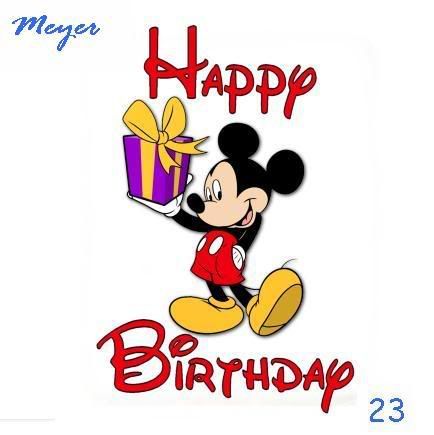
Happy Birthday Meyer:-)


A wonderful day for Meyer. 3rd Oct..Her big big day…

1st thing to surprise her in the morning was I had order a bouquet of roses from Ideal Florist in I-Avenue. Prepare this since Sun to prevent some disappointment for roses not available. Hey guys, fake roses are more expensive that the real one. Somemore it will be after 3 or 4 days. Darling, i know you love blue roses J Blue roses with colour spray will stand for 3 days only le..

After few days I receive a fwd mail from my colleague about a mail circulated around the company about a luckly girl who received 1001 roses from a secret admirer!
This is definitely worth a post here. 1-0-0-1 roses..But is this really true love? Or just to win the girl's heart? (Hehehe..Sorry le Meyer..What you get cannot be compare as below, dun angry ya :-P) But 1 thing can prove to you that your roses will be everlasting..Wonder what happen to the roses below after 10 days?


Wow…

Night time will be a surprise for her as she still cant figure out where I bring her for dinner :-P Let talk about the place Audees now..

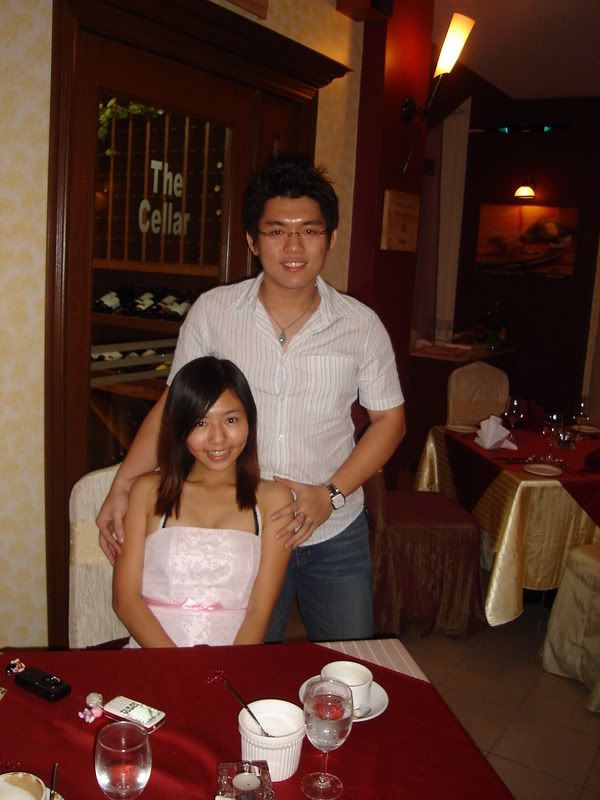
We were welcome by 2 waiter to our seat since I have made reservation earlier. 1st we feel not so comfortable as we are sitting neat to the counter but sooner will be use to it as the view near us still satisfy with Spanish base bear, TORRES deco in the centre. The set dinner came with a nice appetizer, soup and garlic bread. As for the main course, I have a steak while the lady had a chicken. Her one is nicer, with chicken meat rollup in pieces. Our dessert is ice-cream with fruits and since Mid-Autumn festival is around the corner, we have jelly mooncake on the house. The coffee is a bit bitter but that's the least of my complain. Add at least 3 tea spoon :-S

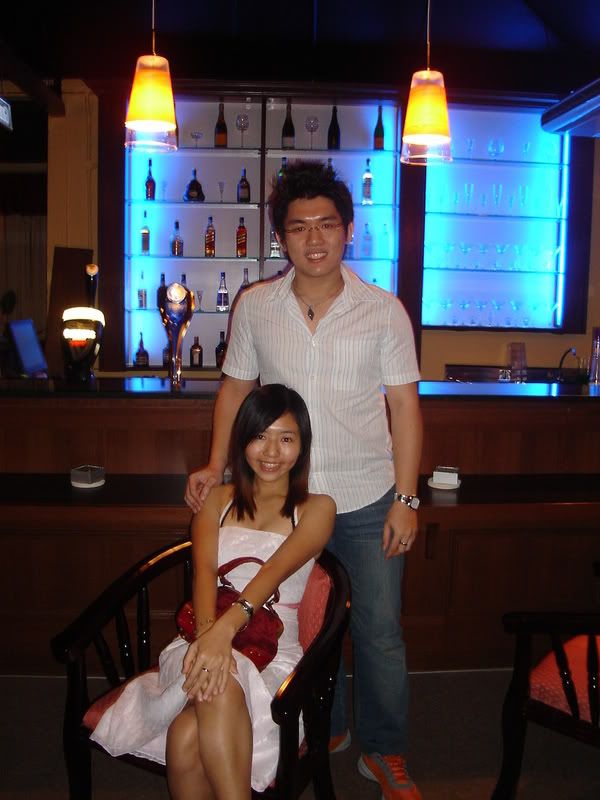
By the time we have finished our dinner, we got offer from the supervisor in Audees to take some snap shots for us. See… His technique of snapping was good as Sony camera need to hold it firmly for night shot.

We were bring to the upstairs which is a bar. It was nobody there now as the happy hour will start on Fri as many people will be hanging there to relax from their daily hectic working days.


Saturday, September 30, 2006

Old Town Coffee@Tesco E-Gate

1st Old Town Hainannese Coffee in Penang

Rated: ***

Modern design of Malaysian style Kopitiam with marble table, laminating "coffee history" on the wall.
Just loacated next to Starbucks E-Gate. The food, all from local delight, from all the local coffee blend to toasted bread with kaya and butter to Nasi Kunyit and curry mee. The food is relatively simple and not overpriced. As this is a premium type of coffee shop, the food is not cheap either.

A set of Omega soft boiled eggs and a double Old Town kaya and butter toast would set you back RM3.60. The nasi lemak special is priced at RM5.80.
Drinks are cheap compare other restaurant along the row.

The drawback is quite noisy inside as expected "local kopitiam" style. Go along with a group of friends chit-chatting should be good idea for a cup of white coffee value. most probably during weekend and lunch time for Fri, the place is most crowded for it strategic location as people coming out from Bayan Lepas FIZ. I wonder can this be extended as Queensbay will be opening soon end of this year. Penang biggest and longest shopping mall.


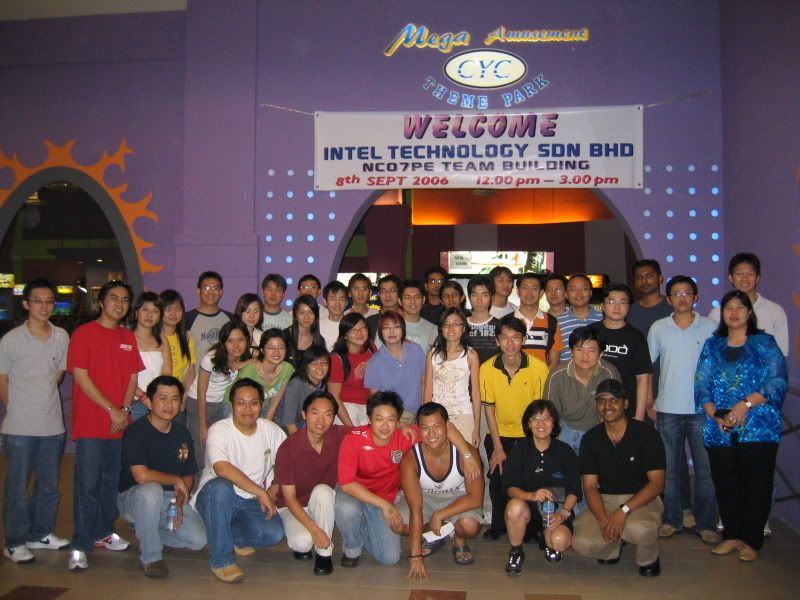
Team Bulding 9 Sep 06'

This was my company team building for the whole department of NC07 PE in Gurney Plaza.
Last year it was held in Parkroyal Hotel with various games and activities.
Not bad to have 1/2 off for the day on Friday 9 Sep :-) Although i reach there ~3pm. But the Cosmo staffs still let us continue with the amusement park game till 3.30pm before we take family photo to end up that we have been here.


The attendance rate is quite good. Most of us turn up for this round. Actually the Amusement Park opens for us from 12-3pm. We all have been given RM10 McDonald coupon for lunch. After that, one movie ticket for you to select which ever movie you love.
Ofcourse i buy another to watch with Meyer for tonite 9.30pm. She has decided to watch something horrible when i ring her up for opinion. At last i decide to buy the Pulse movie ticket.

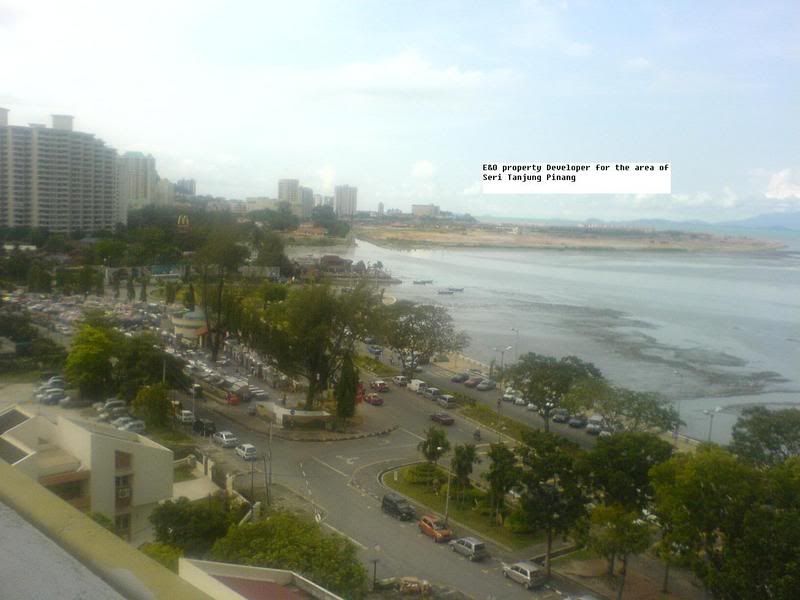
1st time i have been in the complex for less than 1 hr.Normally more than 2. Before I drive out of the carpark, I able to snapshot the whole surrounding of Gurney Plaza from my SE W810.


With te Penang 2nd link bridge and Monorail to be implement by government, the area of properties will be very demand. Wonder how many times from the current price 5 years later.